Word on a Whim

Old Dog New Tricks

This was supposed to be a blog that was mostly about writing – only I haven’t written anything recently, nothing in English, that is.  At work I write computer programs but the switch from iSeries RPG to web front-end C# with Sequel Server has resulted in me coming home feeling utterly mind-fucked; my head a cage-full of monkeys as the ideas of the fiction I might write come and go amidst the frustration of knowing exactly what the system I am working on is supposed to be doing, but not having the language skills to make it happen.  Then the nights are full of mind-loop dreams of unsolved and surreal problems that I would never get to the bottom of, if I tried all night, because they do not exist!  And there is the nuisance of Christmas approaching.

I don’t really have the aptitude for C#.   I believe it was created by a bunch of … gents who were concerned that higher level languages were a threat; opening the IT doors to none-IT staff.  Unfortunately, it has also closed doors for some veteran programmers, and I thought I was going to be one of them.

The transition from ‘top down’ to ‘object oriented’ programming has not been sudden.  The system I had worked on for hundreds of years was decommissioned some time ago and I expected to go out with it.  I was glad to be kept on but the deadlines for the latest project were particularly tight and I found I was doing extra hours at home, weekends and evenings, in order to just about keep up.  I am lucky enough to work with a small team guys who are not only technically brilliant but good friends too, and supportive – but I am determined I will not be carried by them.

I am picking up the new skills, slowly.   If you throw enough mud at a wall some of it will stick, but all the mud that has hit and slid away has been depleting, and all I have done in my spare time is easy-reading and nosying on friends’ Facebooks.   I am tentatively confident that this is about to change so that work can stay at the office and I can put some disciplined thought and time into another writing project.

Keep warm, and try not to get too muddy 😉

Jules

Sunday Ramblings

Most Sunday mornings I run along the riverside path with Gandalf.  When I say run, it tends to be very stop-start, because he is a hound dog and does what doggies do in that particularly stubborn way that is characteristic of the hound.  He is a lovely companion, partly because he does not speak, and if we pick a time when there are not too many other people and dogs around, this is our special time together – and the time and place where much of my fiction is created.

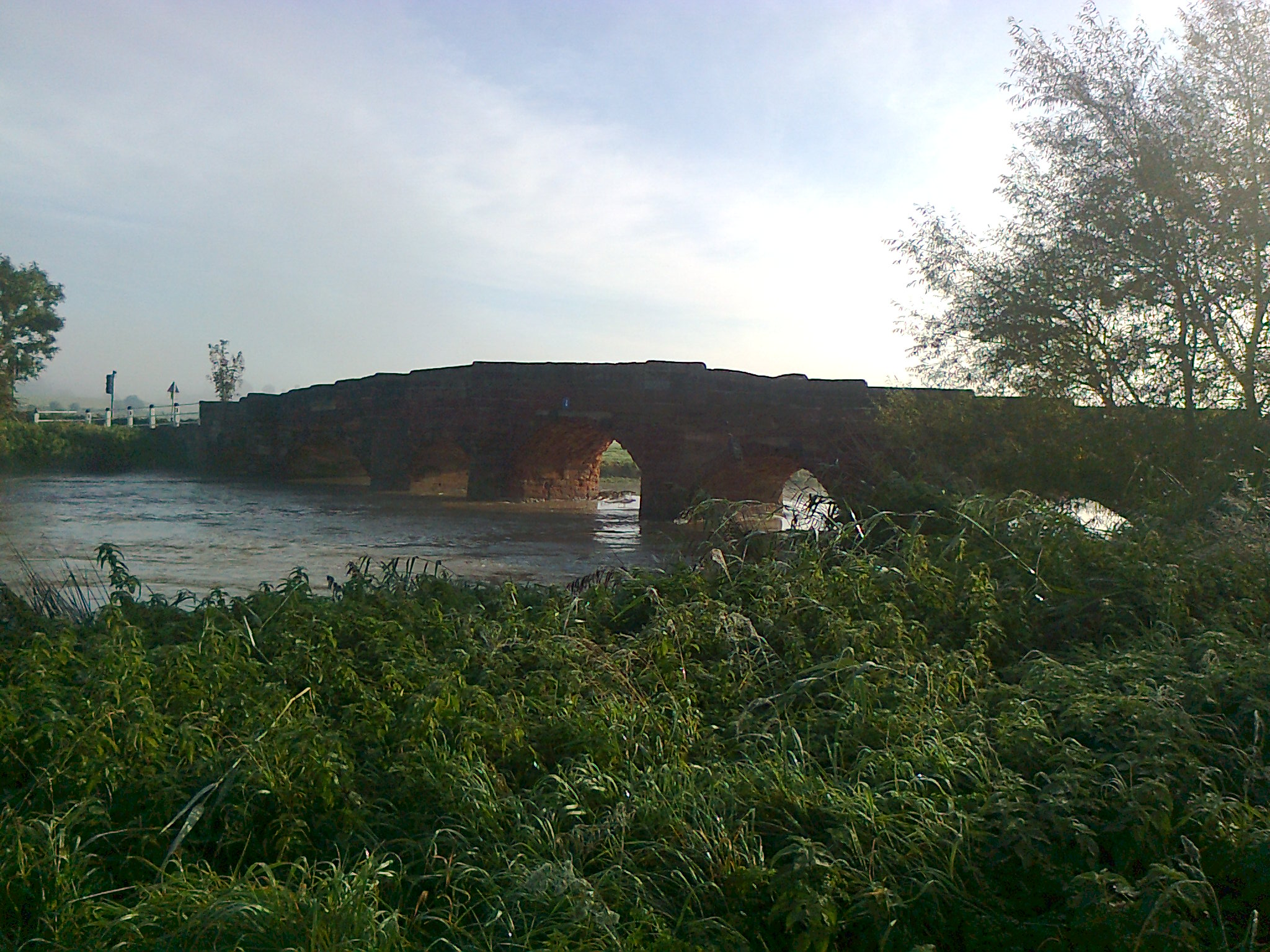
Often the route is dark, dismal and muddy. This morning the sun was burning off a heavy mist, so it was atmospheric, whimsical … and muddy.  I have never seen it looking so lovely.  I had a mobile phone in my pocket with a camera on it and decided to take some photos along the way.

Gandalf used to bolt under this bridge because the first time he went under it a train went over and freaked him out.

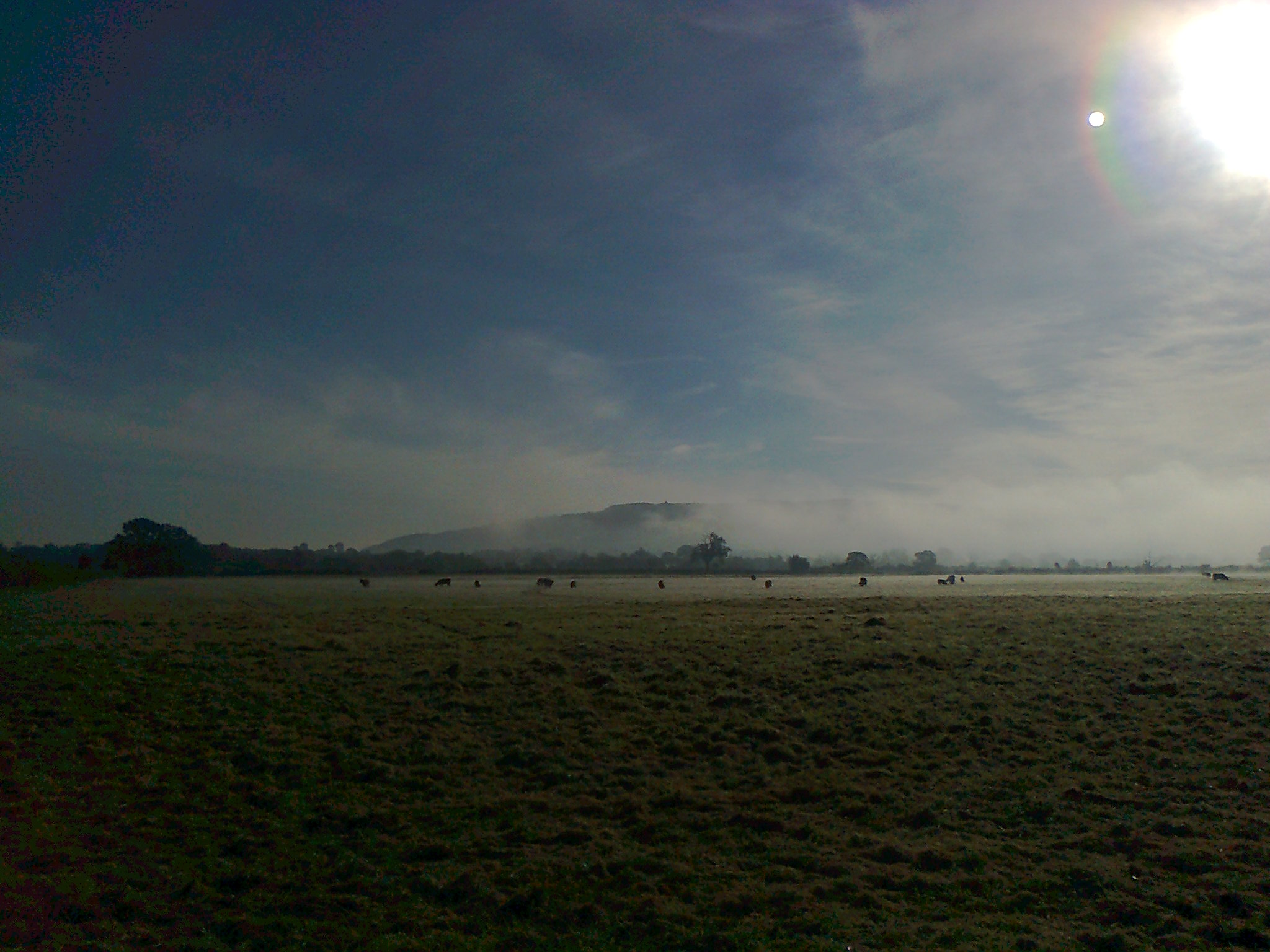
Those are cattle in the distance, standing in an area where the mist hadn’t yet burned off.  Aberdeen Angus, I think.  Shaggy ginger ones with really cute faces.

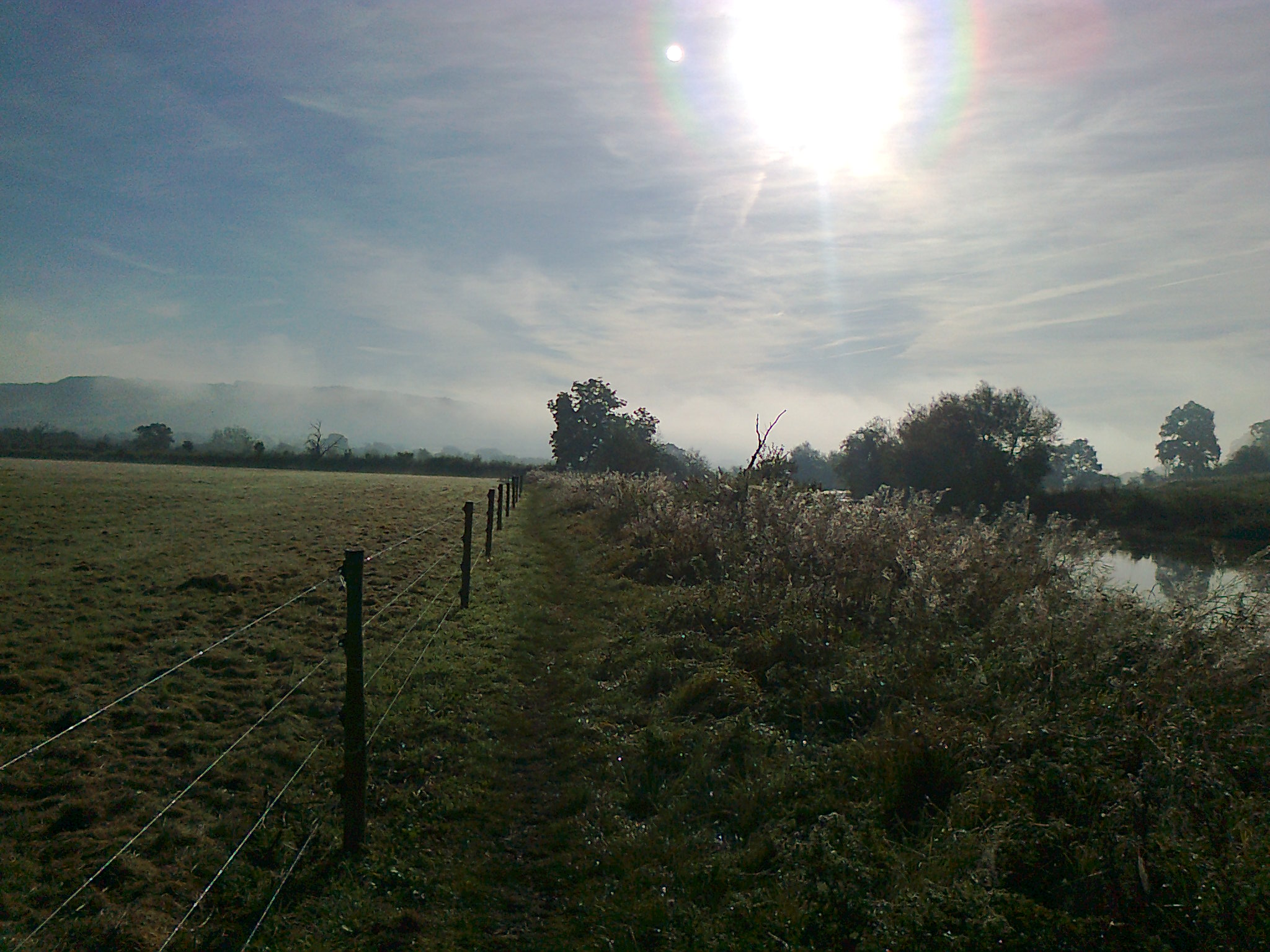
I don’t know much about photography but was always told the light should be behind – but I was trying to capture the heavy dew and the impressive network of spiders’ webs – and it could only be seen from this direction.  That fence has an electric current running through it to keep the cattle in the field.  The path gets quite narrow in places and poor Gandalf once touched it and hollered like hell.  I touched it myself and wondered why he’d made such a fuss – but I was wearing rubber soled shoes.  Gandalf’s hu-dad went along another day, took his shoes off and touched it, and his hand was stinging for hours.

These two guys wondered what the silly cow was staring at.

The foreground is mostly cobwebs and dew, the bit in the middle is the river and the sky has chemtrails.  (Oh, don’t start on about those again).

When I took the photos, Gandalf was either up to his ears in an interesting smell, or else marking ‘Gandalf woz ere’ on it – so I didn’t take any pictures of him by the river … but here he is back home; washed and fed and no longer smelling like a swamp.

Wishing everyone a peaceful Sunday,

Jules x

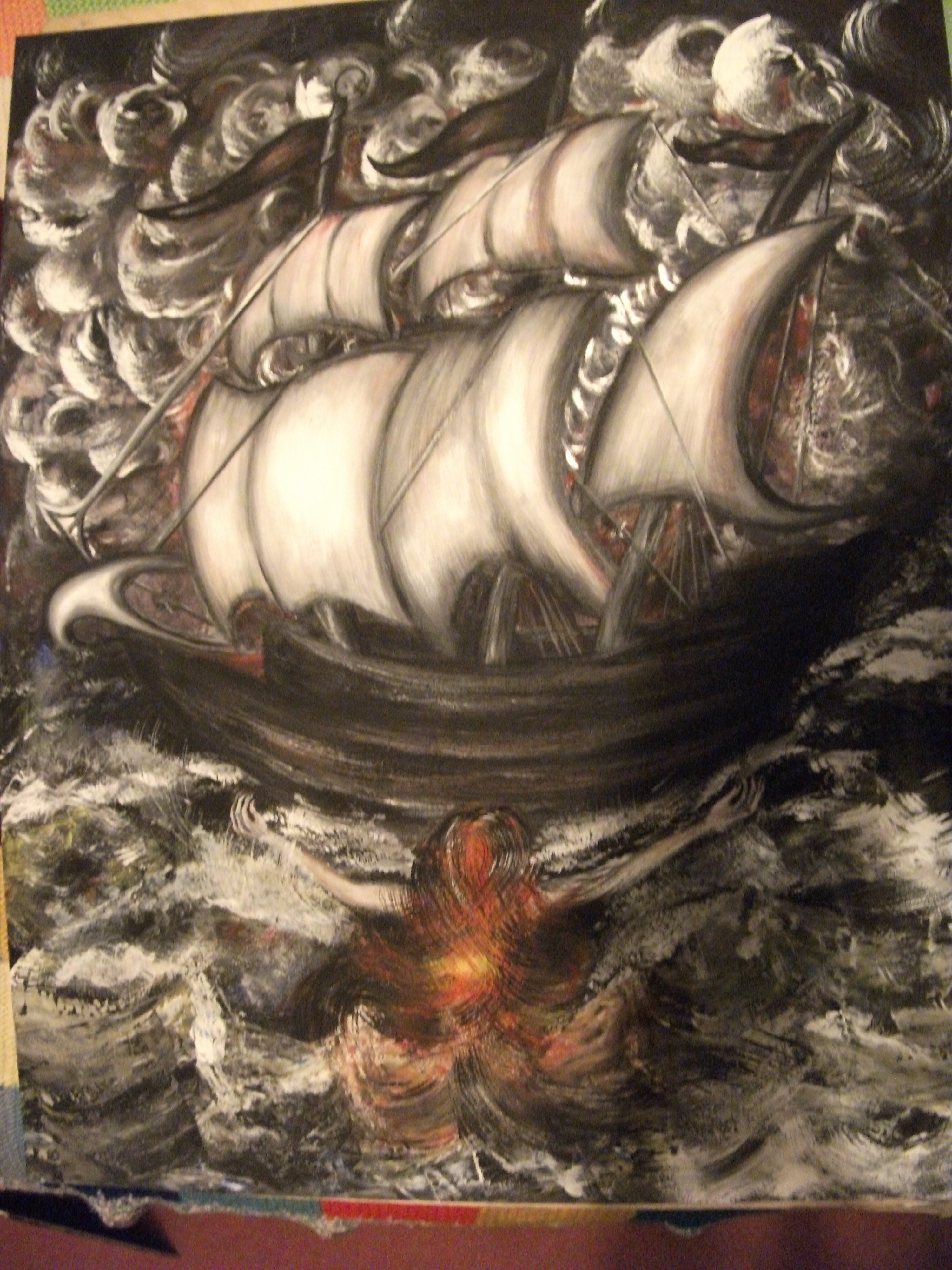
If a picture paints a hundred thousand words: painting compared with writing

I used to try to paint pictures … many years ago. I was never satisfied with the finished effort, which wasn’t anywhere near as good as the picture in my mind that I was trying to replicate.  My subjects were usually imaginary creatures.  I would picture the main subject; maybe a dragon coiled in front of a Gothic castle, and sketch the outline but then when I came to fill in the background the mind work would begin.  Was the castle on a hillside?  How much of the background was sky and how much was land?  What kind of sky or land?  Was the light-source from the moon … if so, from what angle?  How about the dragon; was it dozing, or warily guarding the castle, or angry and fearsome?  Should the dragon be painted in fine detail, down to its individual claws, or would an impression of claws be more effective?

Painting a picture has some parallels with writing a novel.  The novel starts with a visualised scene or an idea that inspires the writer to create a plot that includes the central characters – the secret friends who are with you night and day.  You already know, understand and admire them, and you want the reader to feel the same about them.  For this to happen you have to think about the details.  How do your characters react in given situations? How about their style of speech; the way they dress, the way they move?  What sort of homes do they live in?  Has anything significant happened in the past that has shaped them?  Could some of this detail be narrated or would it be more effectively conveyed as an impression through their actions and dialogue?

Writing suits me better than painting – and not only because I get better results with no mess to clear away afterwards. When I used to paint, if I realised too late that the composition was wrong I found it impossible to salvage, whereas with a novel I am able to go back and change the beginning or insert extra chapters or add some twists and turns to make up the length if required – although I’m not sure how well that would work if I was asked to provide a synopsis prior to beginning a novel!

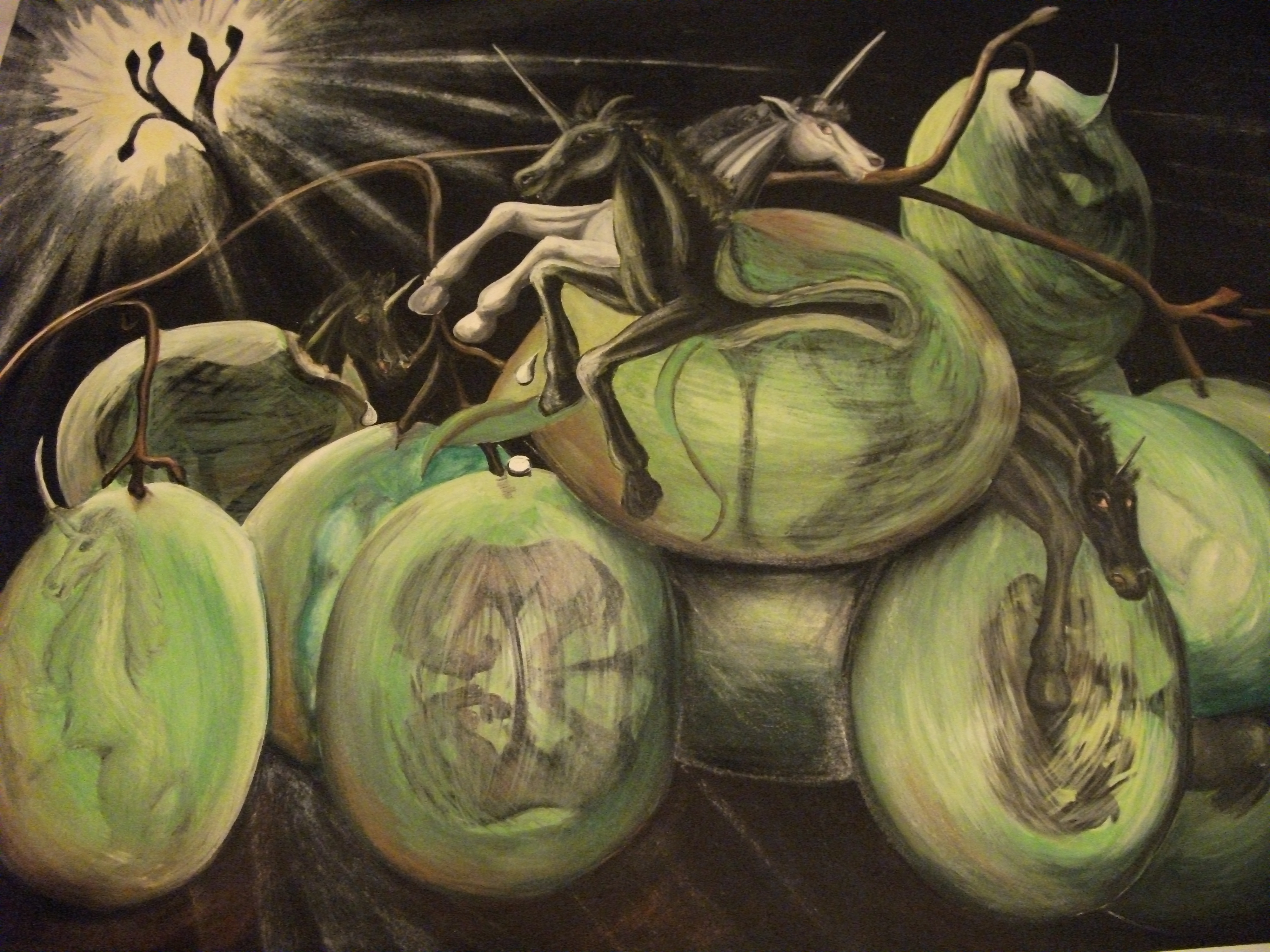
Lately I have been trying to clear things out of the house to make some space.  I still have my large art folder containing the artwork I did at school thirty years ago!  I can’t keep such things for ever but there are a few pictures I might hang on to. I will throw out my paints though – they can’t be much good after all this time!  I decided to take photos of the best few pictures and post them on this blog.  Then, if I decide to chuck the lot out there is still a record.  I never improved on my school work, and the photographed images somehow look better than the real things – and I like to see pictures on the blog.

So here they are …

Screenplay Finished

I have just finished adapting ‘The Rise of Serge and the Fall of Leo’ into screenplay format.  When I say ‘finished’, I am still going to have to give it a final read through before sending it off – but the last thing I want to do with something I have just finished writing is to read it. I still have time for that later, as the BBC Writers Room has not yet published its open dates for the autumn Script Room submissions window.

Re-writing the story as a screenplay meant that I had to cut it down to its bare bones to keep the running time within two hours. This meant omitting any scenes that were purely for entertainment value; scenes that did not progress the story towards its conclusion.  Serge and Fran’s wedding ceremony had to go, which I thought was a shame, but for the sake of the plot it was sufficient to see them living happily together.  For elements that were essential to the plot but would have used up too much screen time, such as Leo’s developing relationship with his son, I resorted to a montage but regretted having to gloss over scenes that I would have liked to see played out in full.

My conclusion is that the story would make a better multi-part drama series than a film, and one day I might re-write it as such, giving it all the time that it needs … but not right now!

The BBC is not looking for ideas to produce – the script readers are looking for writers they can develop. They receive thousands of scripts each year so I mustn’t be too hopeful.  Writing seems to have become so ‘closed doors’ that I am grateful to them for offering an opportunity for unknown/unrepresented writers to send in unsolicited scripts. After the closing date for submissions, if I am not contacted with two months, I must assume they are not interested.

Whatever the outcome, I get a little dream to float on during autumn …

Jules

Chemtrails

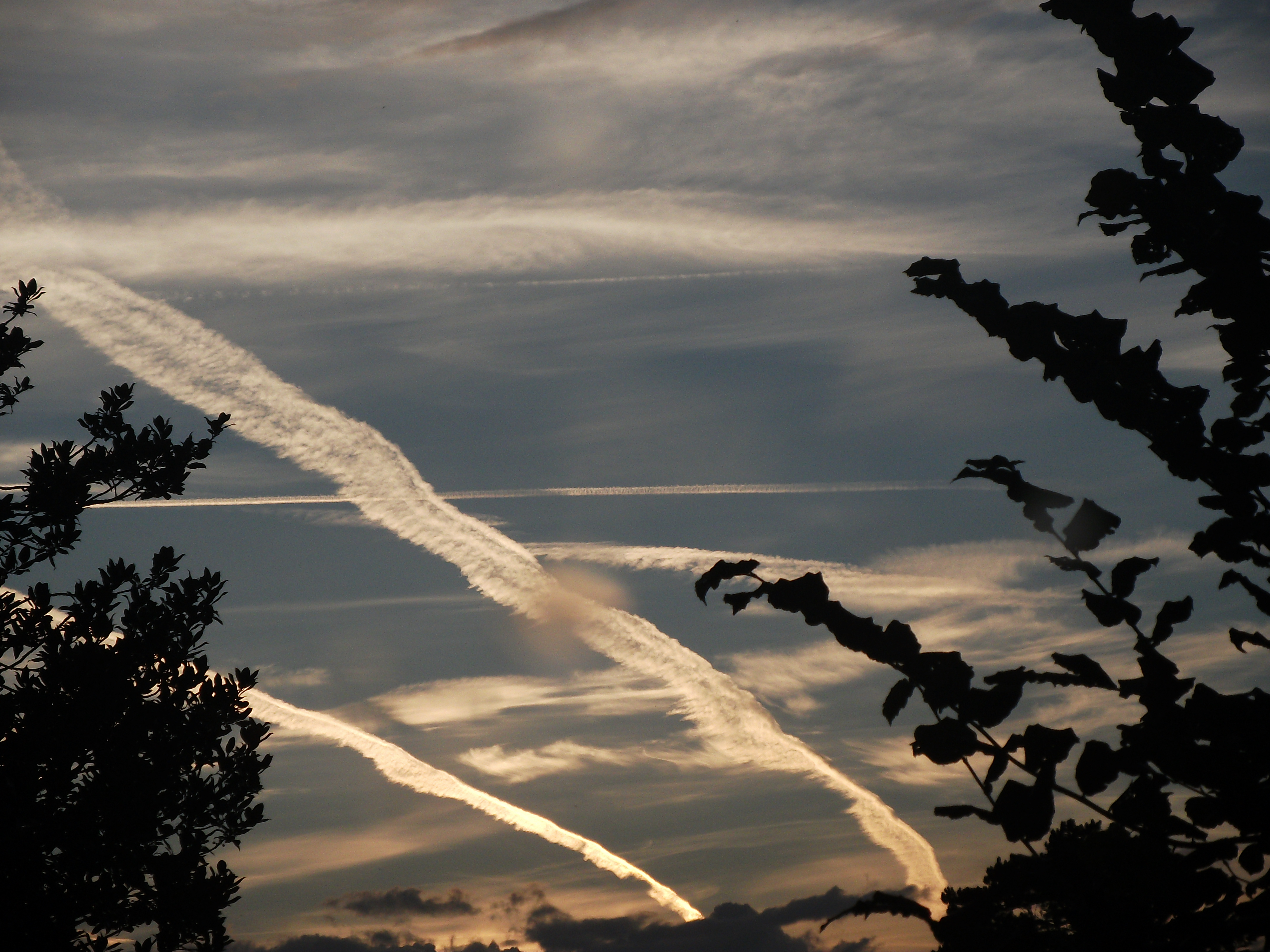
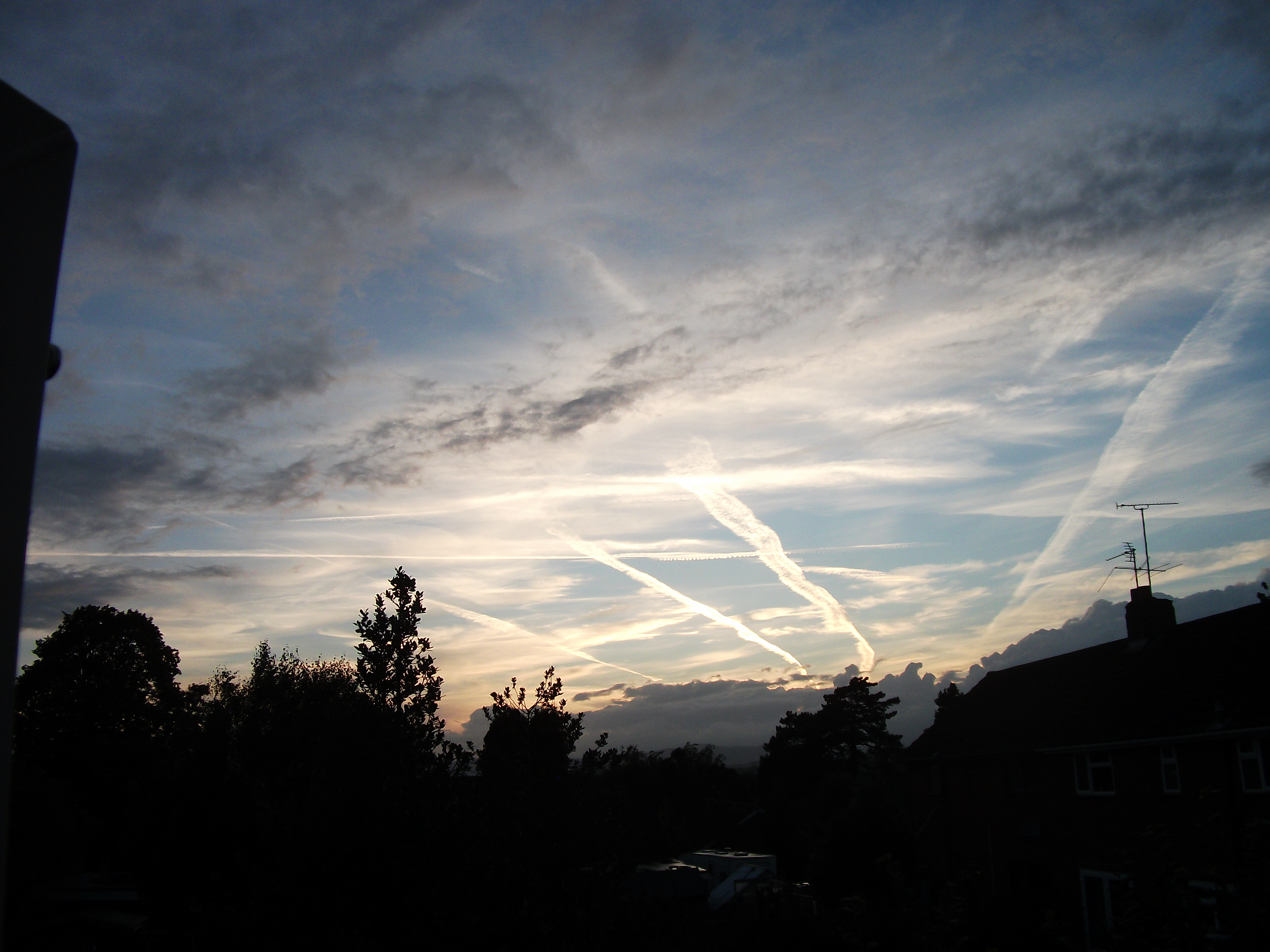
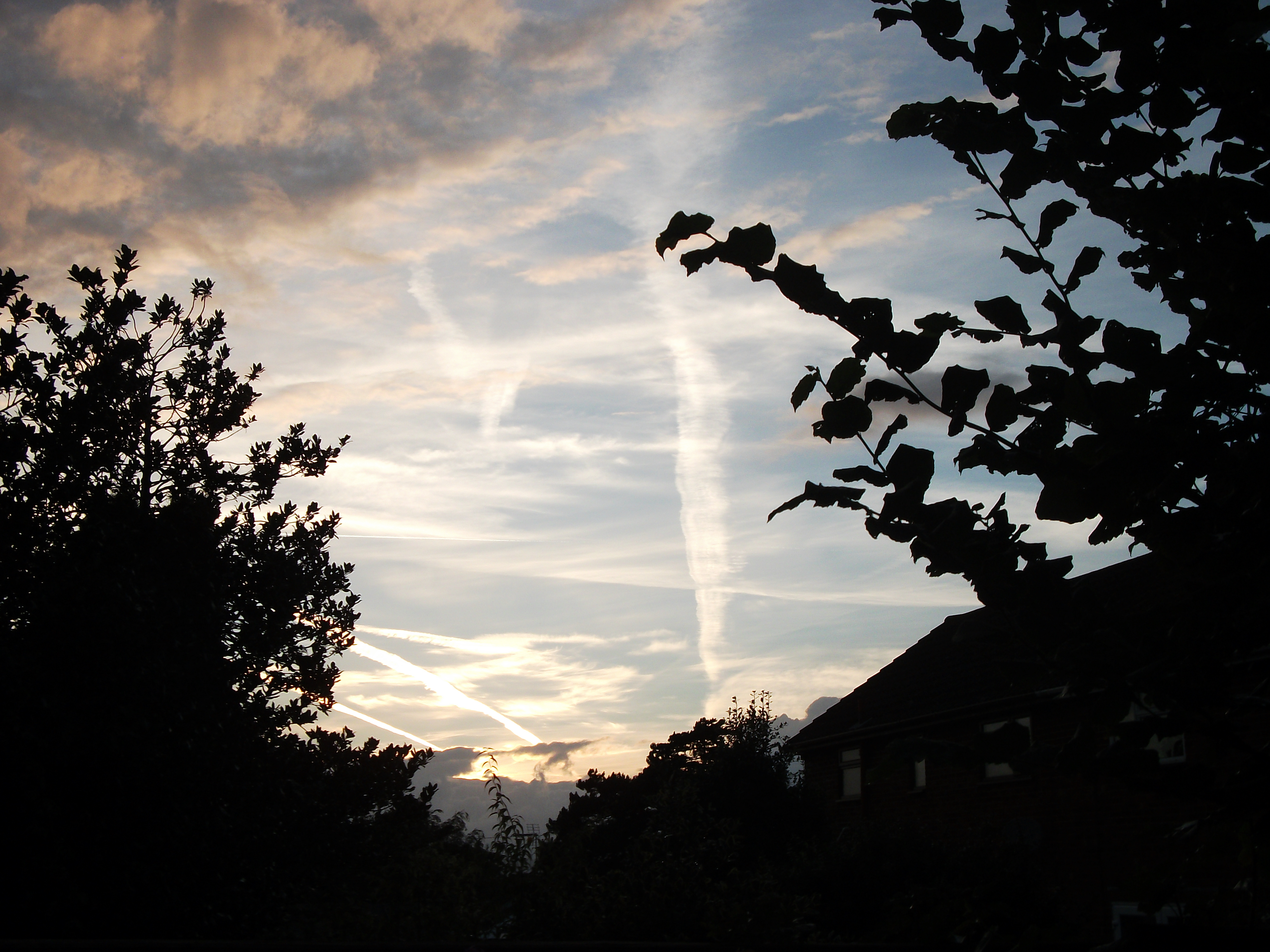
Sorry to bring this up again when I already did it back in May, but I have a few photos to share. This time there is no plane – just the chemtrails. It’s worth mentioning that you don’t hear the planes except sometimes at night. These lines are made by high flying passenger planes.

The photos above were all taken this evening, from the back garden.

I took the photo below one evening last week when there had been no obvious activity and there was simply a nice sunset:

If anyone wants to learn more about chemtrails, here are links to some full-length documentaries:

Why in the world are they spraying?

http://www.youtube.com/watch?v=mEfJO0-cTis&feature=player_embedded

What in the world are they spraying?

http://www.youtube.com/watch?v=BARt9ccu8no&feature=player_embedded

Oh to be invisible, or to always know what to say …

Sometimes I wish I were invisible … or had better social skills.

Running is meditation for fidgety types and I have enjoyed it for the best part of thirty years but still feel a wally when I meet anyone, especially if it’s someone I recognise.  The worst scenario is seeing a neighbour in the distance, approaching along a straight lane.  Does it look silly the way I am swinging my arms?  Would it look sillier if I kept them still? At what point am I supposed to start smiling at them?  Running for half a mile grinning like an idiot can’t be right, so should I grimace at the road right until the last minute then look up and shout “Hello” just as we cross paths?  There is also the issue that I never feel “Hello” is enough and so end up talking about the weather or something – which leads on to the awkwardness of saying “Goodbye” and then suddenly sprinting off again.  Worse still is when I start to catch up with someone who is ‘jogging’ as opposed to ‘running’.  I feel a bit of a bitch for overtaking, like I’m showing off or trying to make them look slow but I have to go at my natural pace, which is variable but generally slower these days.  My stock remark when overtaking other runners is, “Did you think you’d got an echo?  Ha ha.”

The awkwardness must be something to do with self-consciousness about being seen in motion.  At work, I don’t seem able to walk across the office without checking my watch, messing with my hair or straightening clothes as I go along.

This evening, whilst walking the dog, I had the running scenario in slow motion.  There was an old gent approaching very slowly with the aid of two walking sticks.  I was very conscious of the dog poo bags swinging from my left hand (I’ve never been the designer handbag type!) and I could see he was drawn to them.  Although the bags are black, there is something about the contours and pendulous nature that makes the contents instantly recognisable.  And this evening, I had been blessed with four offerings.

“Who’s taking who a walk?” he asked (which is a common variation on “Why don’t you put a saddle on his back?”)

“More like ‘Who’s taking poo a walk?’” I answered, with a little flourish of my trophies. He chuckled, bless him, but I cringed at myself afterwards.

I think it’s something to do with the village mentality; where people who know nothing about each other exchange pleasantries (or sometimes unpleasantries if you’re as socially inept as I am).  When I lived in Leeds, some years ago now, people I didn’t know would have thought I was nuts if I shouted “Hello” at them whilst running past. 


Sunday Evenings

I always feel ‘down’ on Sunday evenings.  I think it must stem from hating school. What didn’t help at the time was grown-ups saying that schooldays were the best days of your life. Just as well I didn’t believe them!  But then I was miserable in the first job I had straight after school – I simply could not please the boss and dreaded every day.  Only after I got another job and moved on did I learn that this woman had a reputation for bullying the ‘office junior’.  Fortunately, most were more resilient than I was.

Even if there is no school or work on Monday, that Sunday Evening feeling is always there.  Sunday: the worst evening of the week.

Things that have, over the years, shaped the Sunday evening:

  • “School in the morning” (said by a parent or grandparent)
  • Homework that has somehow been left until Sunday night
  • Double maths first lesson on Monday
  • Having to go to bed early when you got up late
  • Sunday dinner’s lingering smell – especially cauliflower which somehow manages to lurk half way up the stairs
  • Leftover cold chicken carcass, smelling like a dead body in a morgue (not that I’ve ever smelt one)
  • Depressing TV programmes that other people like to watch
  • Making sandwiches for tomorrow
  • Setting the alarm for the morning
  • Wondering what to wear and wishing I’d done some ironing
  • What if it’s snowing in the morning?
  • What if the roads are flooded?
  • Remembering I’ve forgotten to check my oil, water and tyres
  • Lying awake reuniting with Friday’s unresolved work issues
  • Lying awake yawning and getting cross because I’m not asleep and the alarm will go off in less than two hours
  • Getting cross because I had to look up whether ‘lying’ or ‘laying’ is correct and I’m still not convinced 😉
  • All that writing I thought I would have done, and I only did half of it …
  • Urm … Any that I’ve missed?

I guess Friday evening is the compensation.

Happy New Week!

Jules

Is it just a case of thinking too much?

There is a blog that I discovered by chance, that I really like. I only found it recently and there are lots of past posts to dip into and enjoy.

Now here’s my dilemma. It seems natural, if I’ve enjoyed a post, to click ‘Like’ to acknowledge my appreciation. But I don’t know this guy; we’re never likely to cross paths, and I’m worried that I might annoy him if I ‘Like’ too many posts – as if I’m leaving my mark all over his blog. I have resisted the temptation to comment on more than a couple of posts. I get the impression he has a large audience that is mostly silent.

Lately, he has been posting a daily photo with a caption. So, I like the photo and click ‘Like’ on it. Then the next day, there’s a photo I like even more, so I click ‘Like’ on it.  Then the next day there’s another good one – but it wouldn’t be there if it wasn’t good, would it?  If I don’t click ‘Like’ on this one, will he think I don’t like it?  He probably doesn’t care. I’m sure he doesn’t think, “So what’s wrong with that photo?”  He sounds like a really busy chap, so he probably doesn’t even notice.

I wonder if anybody else agonises over whether to comment or not? Or do other people just do it? Or not?

Tense?

All the books I wrote before ‘The Rise of Serge and the Fall of Leo’ were written in the past tense, which I believe is the more traditional style of telling a story.  I wrote those early stories without having to give a thought to the grammar – it just seemed to flow. With the Serge character, I felt that the present tense seemed appropriate for Serge’s outlook; he lives in the present moment and his actions are responses to what is happening right now.

I started my latest book in the present tense, as this now feels more natural to me, but at the end of the first chapter I decided to do this one in the past and rewrote it.  Rewriting it was more than just a case of sticking ‘ed’ on the end of words as I found that some bits just didn’t sound right and had to be rephrased. Moving forward, if I finally settle with the past, I will have to concentrate to use ‘said’ instead of ‘says’ and so on, until it becomes natural again.

I did go looking on the internet to see if people had tense preferences, and I think it was this comment on a forum that swayed me towards the past:

“Reading an extended piece in present tense often makes me feel as if I’m being hit repeatedly over the head with a teaspoon.”  (Emma)

I kind of know what she means, but yet it was this same quality that I felt gave my book a freshness, a faster pace and a sense of the seasons rolling quickly by.

To help me decide, I took an extract from ‘The Rise of Serge and the Fall of Leo’ and converted it into the past.

Here it is in the present tense:

Leo has had enough – it had been funny and intriguing at first – but now he will block the number.  Better still he will plunge the mobile into the water – as far down as he can sink it – and then jump in after it and follow it down to the depths where the water turns to mud.  He raises it above his head to achieve the maximum downward thrust but slips on the ice and falls to his knees – the phone flying from his hand and almost slithering over the edge.  He remains kneeling on the ice and clasps together his painfully cold hands, and sobs in despair…

  “Oh, Lord.  If you really do exist – as my mother believes you do – then please don’t let me ruin her Christmas.”

… and this is my ‘translation’ into the past tense.

Leo had had enough – it had been funny and intriguing at first – but now he would block the number.  Better still he would plunge the mobile into the water – as far down as he could sink it – and then jump in after it and follow it down to the depths where the water turns to mud.  He raised it above his head to achieve the maximum downward thrust but slipped on the ice and fell to his knees – the phone flying from his hand and almost slithering over the edge.  He remained kneeling on the ice and clasped together his painfully cold hands, and sobbed in despair…

  “Oh, Lord.  If you really do exist – as my mother believes you do – then please don’t let me ruin her Christmas.”

Have I got myself confused here? Do I need to change “will block the number”, “will plunge” and “can sink it” to “would block the number”, “would plunge” and “could sink it”, or are they still valid in the future when I am writing in the past?  I think I could have got away with the future, but it grates a little when followed by “He raised” instead of “He raises” – or would that read okay to everyone else?

Anyone’s feelings or advice on this will be very much appreciated and will help me to decide whether to go forward in the present or the past.

Thanks,

Jules

Opportunity to become a script writer

Alongside starting another novel I am having a bash at writing a film script.  The BBC offers ‘windows of opportunity’ for writers to submit scripts – not only for films but for TV drama, Radio drama, TV sitcom, Radio sitcom, Children’s drama and Children’s sitcom.  It is unlikely that submitted scripts will become productions as the BBC is not looking for ideas but for script writers who show strength and originality and can deliver their idea effectively in script format.

Since “The Rise of Serge and the Fall of Leo” is still firmly etched in my mind, it makes sense to me to base my script on this story.  (You are only allowed to adapt a novel into a script if the novel is your own work).  When I was writing the novel I could see it played out as a film and I can still see the images, so my challenge now is to convey the images within the script but without explanation or narrative.

The action sections in the script must be concise, and the characters must be portrayed through their dialogue and not through my description of how the actor should deliver the lines, since actors apparently resent being directed by the script writer.  I struggle with this and find it tempting to use parentheticals (‘wrylies’) to put across the tone of the dialogue; (brightly, sadly, flippantly, wryly) and, just looking critically at the excerpt in the photo above, I think my action sections might be too detailed.

Feature films are generally 80-120 minutes long; the length being important to fit into scheduled time slots between regular TV programmes, or to allow optimum screening at the cinema. I guess this is why, when you watch a film after you have read the book, you keep thinking (or saying out loud if you’re very annoying) “That’s not what happened in the book”.  The length of a film is gauged approximately by the length of the script, a rough guide being one page per minute, so I will have to butcher my story quite ruthlessly to fit it into 120 pages of script, and the story line may have to change so that essential characters can be retained when their key scene in the book has been excluded.

The BBC states that the competition is extremely tough and they receive thousands of scripts every year and can only concentrate on a selected few, but nonetheless, this is an opportunity for new writers to get a foot in the door.  The manuscript must adhere to a strict format, but don’t be put off by this; there are plenty of examples on the internet and on the BBC website, and once you get started it does begin to flow.  I downloaded a free template called Script Smart, but I have read that templates are available in Microsoft Word.

The next opportunity to submit a script will be some time in the autumn (dates to be provided).  Here is the link if anyone else fancies giving it a try:

http://www.bbc.co.uk/writersroom/send-a-script

Good luck,

Jules

Post Navigation